
Clients are welcome to visit our new home – We also provide FREE DELIVERIES TO STEVENAGE, LETCHWORTH & HITCHIN
Prefer to call?
Leisure-centre changing and reception upgrades. Survey, finish selection and installation planning for commercial premises.
Existing doors, counters and cabinetry may be visually renewed when their condition makes them appropriate for specialist film. For Swansea, this guide focuses on leisure-centre changing and reception upgrades, where the brief may involve locker fronts, reception desks and dry-area partitions. The substrate governs the outcome, so movement, contamination, damaged laminates and weak finishes require proper diagnosis first.
Evaluate the proposed surface at normal viewing distance and under site lighting, with its surrounding materials visible. Fresh solid colours and light wood effects can be sampled against adjacent floors, walls and furniture before approval. Access planning matters too. Moisture exposure, cleaning regimes and public opening hours should be recorded before quantities and programme dates are fixed.
Depending on the survey and design brief, the material shortlist may draw from 3M DI-NOC, Cover Styl and Metamark MIA. Compare physical texture, sheen, technical guidance, cleaning needs and edge performance before the final architectural film is ordered.
Our commercial architectural wrapping service covers surface assessment, material selection and installation. If your specification names 3M, see our DI-NOC installation service.
For a project in Swansea, send the site postcode and scope so we can confirm survey and installation availability.
Request a quote. Send your project postcode, surface photographs, approximate dimensions or quantities, preferred finish and installation date. We can then confirm suitability, access requirements and the next step.

List each item included in the project, noting dimensions, construction, existing coatings, repairs, corners, handles and removable fittings. For this Swansea brief, pay particular attention to locker fronts, reception desks and dry-area partitions. Image references give estimators and installers evidence of subtle substrate changes across repeated components.
Review fresh solid colours and light wood effects as physical samples on or beside the intended substrate. Check colour, grain direction, sheen and junctions from normal viewing positions. Confirm which dry, stable substrates are suitable and exclude damp or failing surfaces from the wrapping proposal. Sign-off needs the manufacturer reference, colourway, texture and physical sample that formed the decision.
Build the sequence around moisture exposure, cleaning regimes and public opening hours. Confirm delivery routes, storage, inductions, isolation of work zones and who can release each area. Temporary closures have to respect emergency planning, essential services and clearly signed alternative movement.
Close-out records need product identifiers, room references, seam or edge solutions, maintenance advice and omitted items. This supports repairs and later phases. The practical result is targeting visible dry-area improvements without treating film as a remedy for moisture problems. Selective renewal concentrates resources on the visible finish instead of automatically sending usable furniture to waste.
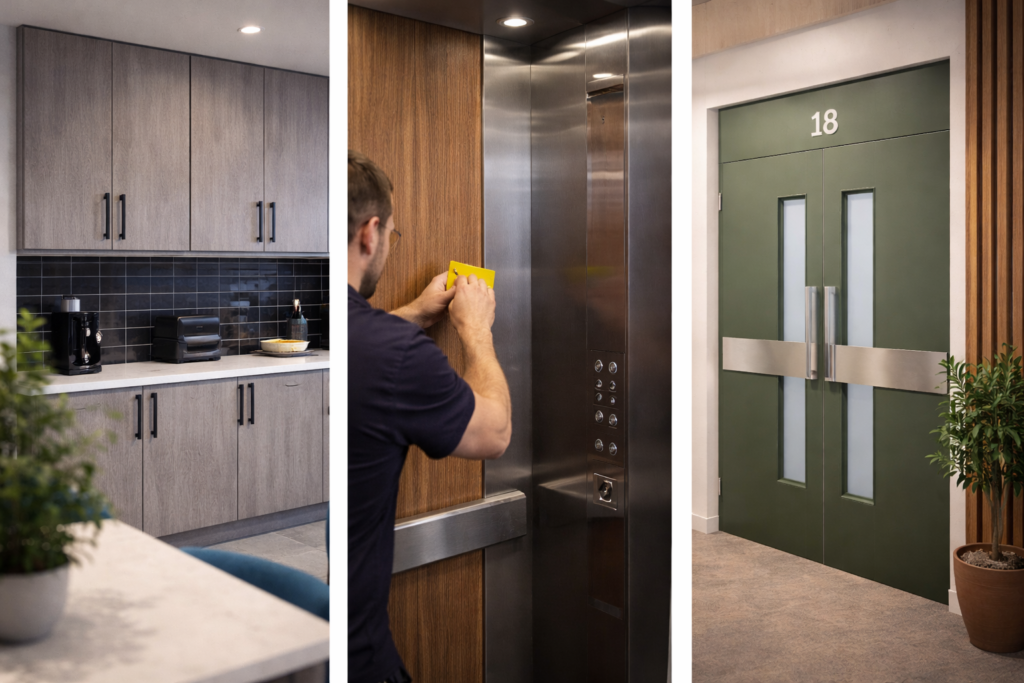
Before ordering architectural wrapping for Swansea, confirm the substrate survey, measured quantities, approved material code, grain direction, edge treatment and installation sequence. Check that the project team agrees what is excluded as well as what will be wrapped. Confirm which dry, stable substrates are suitable and exclude damp or failing surfaces from the wrapping proposal. Keep a visual record of the consented finish with the survey references used for ordering. Document the practical arrangements for materials, entry, protection, discarded backing and post-installation care. Together, the checks produce an actionable specification that can move from quotation to controlled installation.
A leisure-centre proposal needs a firm boundary between dry decorative surfaces and areas affected by persistent water, steam or substrate movement. In Swansea, inspect locker hinges, ventilation slots, damaged laminate edges and floor junctions after the cleaning cycle, when moisture problems are easier to spot. Ask the operator which disinfectants and scrubbing methods are used. A reception counter trial cannot automatically prove suitability for changing-room partitions. Record excluded wet zones clearly and choose colour contrast that supports navigation without imitating statutory safety signage.
The selected film, measured area, condition of the substrate, preparation, edges and access affect the price. Compare the full installed scope with replacement, including repairs and making good, rather than comparing material prices alone.
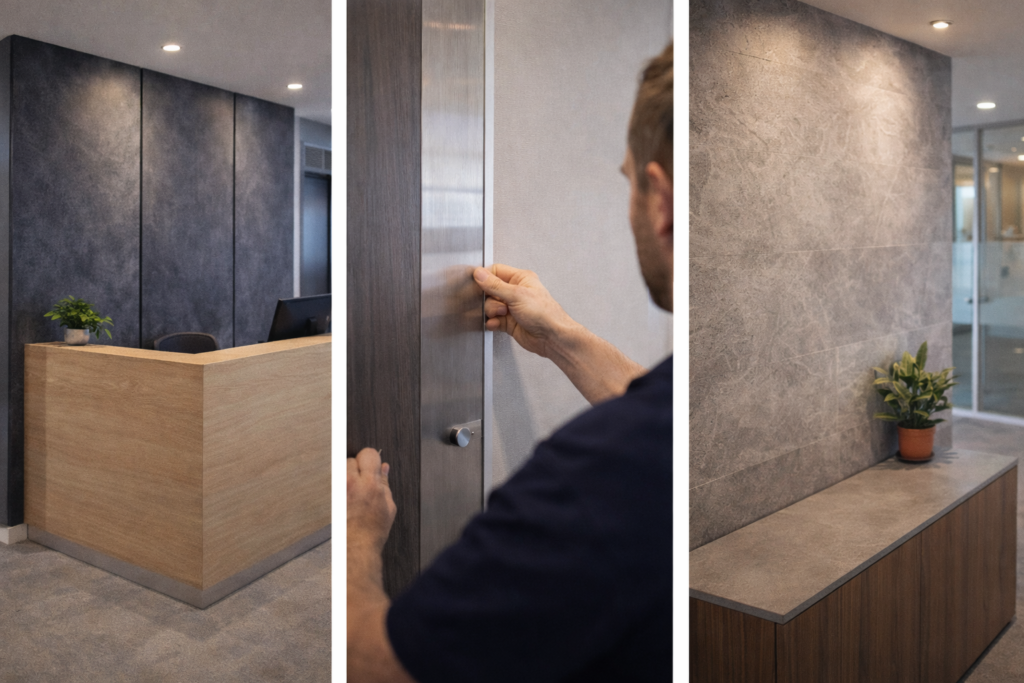
Start with locker fronts, reception desks and dry-area partitions. Each substrate must be stable, smooth enough for the selected system and assessed before a quotation is finalised.
Compare physical samples of fresh solid colours and light wood effects under the actual lighting, beside neighbouring materials, and on a representative edge or corner where practical.
Often yes. The programme should account for moisture exposure, cleaning regimes and public opening hours, together with safe access, preparation time and client sign-off.
No. The substrate and coating must be sound and compatible with the selected film. Loose paint, movement, moisture and damaged edges may require repair or make wrapping unsuitable.
Send the site postcode, photographs, approximate dimensions or quantities, the intended finish and your preferred dates. Include access restrictions and any drawings or product references already specified.
For Architectural Wrapping in Swansea, Smiths 1972 also supports organisations in nearby towns including Llanelli, Neath, Port Talbot and Mumbles. Our team works from Stevenage, Hertfordshire.
Want to discuss your project?