
Clients are welcome to visit our new home – We also provide FREE DELIVERIES TO STEVENAGE, LETCHWORTH & HITCHIN
Prefer to call?
Ceramics showroom display renewal. Survey, finish selection and installation planning for commercial premises.
Surface film offers a way to modernise serviceable fittings while leaving their underlying construction in place. For Stoke-on-Trent, this guide focuses on ceramics showroom display renewal, where the brief may involve sample plinths, consultation counters and storage fronts. A credible proposal separates wrappable surfaces from swollen boards, loose veneers, crumbling paint and other unsuitable conditions.
Texture and sheen should be judged within the room, where daylight, lamps and adjacent finishes alter their appearance. Stone, clay-toned and dark matte effects can be sampled against adjacent floors, walls and furniture before approval. Access planning matters too. Heavy samples, impact-prone edges and changing collections should be recorded before quantities and programme dates are fixed.
3M DI-NOC, Cover Styl and Metamark MIA all provide architectural surface-film choices. Specification should compare the actual product data, approved samples, substrate compatibility, maintenance expectations and project environment rather than selecting on appearance alone.
Our commercial architectural wrapping service covers surface assessment, material selection and installation. If your specification names 3M, see our DI-NOC installation service.
For a project in Stoke-on-Trent, send the site postcode and scope so we can confirm survey and installation availability.
Request a quote. Send your project postcode, surface photographs, approximate dimensions or quantities, preferred finish and installation date. We can then confirm suitability, access requirements and the next step.

List each item included in the project, noting dimensions, construction, existing coatings, repairs, corners, handles and removable fittings. For this Stoke-on-Trent brief, pay particular attention to sample plinths, consultation counters and storage fronts. A fixture-by-fixture photo log protects the team from treating non-identical surfaces as one standard detail.
Review stone, clay-toned and dark matte effects as physical samples on or beside the intended substrate. Check colour, grain direction, sheen and junctions from normal viewing positions. Reinforce or repair damaged plinth corners before wrapping and keep removable range labels separate from the permanent finish. The client approval should name the product code, orientation and agreed test panel rather than a descriptive colour alone.
Build the sequence around heavy samples, impact-prone edges and changing collections. Confirm delivery routes, storage, inductions, isolation of work zones and who can release each area. Access planning must keep escape provisions and vital equipment unobstructed throughout preparation and application.
Completion information should join finish codes with fixture numbers, detail photographs, aftercare notes and scope exceptions. This supports repairs and later phases. The practical result is giving product displays a calm supporting backdrop that can outlast individual collections. Keeping serviceable components in use may avoid part of the demolition, transport and waste associated with replacement.
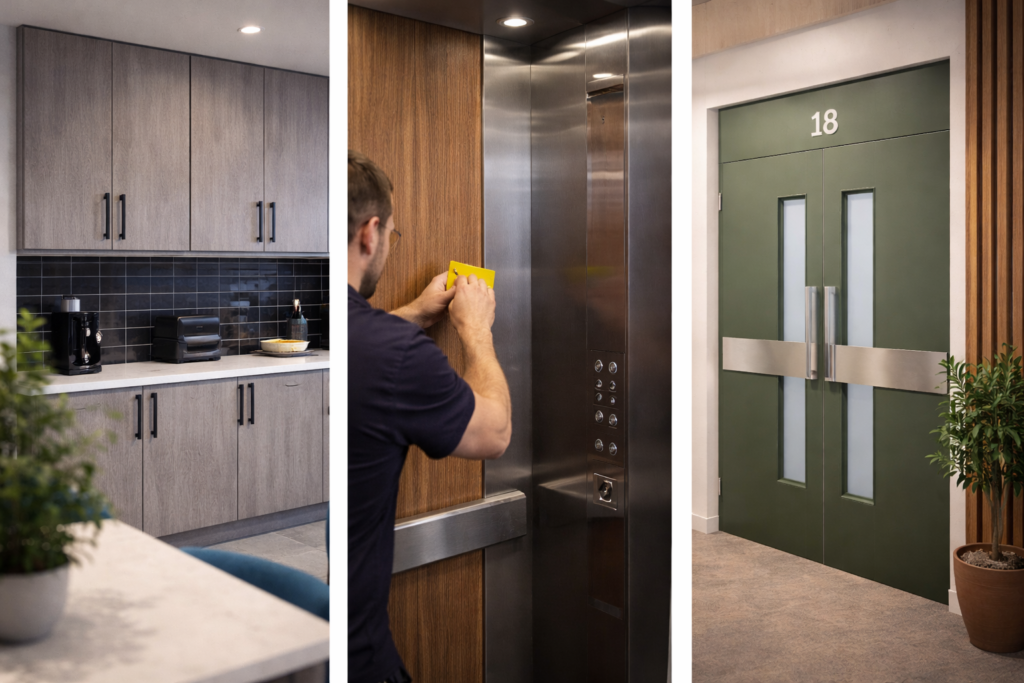
Before ordering architectural wrapping for Stoke-on-Trent, confirm the substrate survey, measured quantities, approved material code, grain direction, edge treatment and installation sequence. Check that the project team agrees what is excluded as well as what will be wrapped. Reinforce or repair damaged plinth corners before wrapping and keep removable range labels separate from the permanent finish. Archive the accepted panel image alongside dimensions, annotations and the client decision trail. The site lead should confirm arrival arrangements, secure storage, work-area protection, waste routes and maintenance briefing. The completed brief explains what will happen, where it will happen and how acceptance will be judged.
Stoke-on-Trent showroom plinths carry dense ceramic samples and often receive repeated edge knocks. Check load paths, adjustable feet and repaired corners before wrapping. Use removable range labels rather than printing collection names into the finish, allowing displays to change without forcing another surface refurbishment.
The selected film, measured area, condition of the substrate, preparation, edges and access affect the price. Compare the full installed scope with replacement, including repairs and making good, rather than comparing material prices alone.
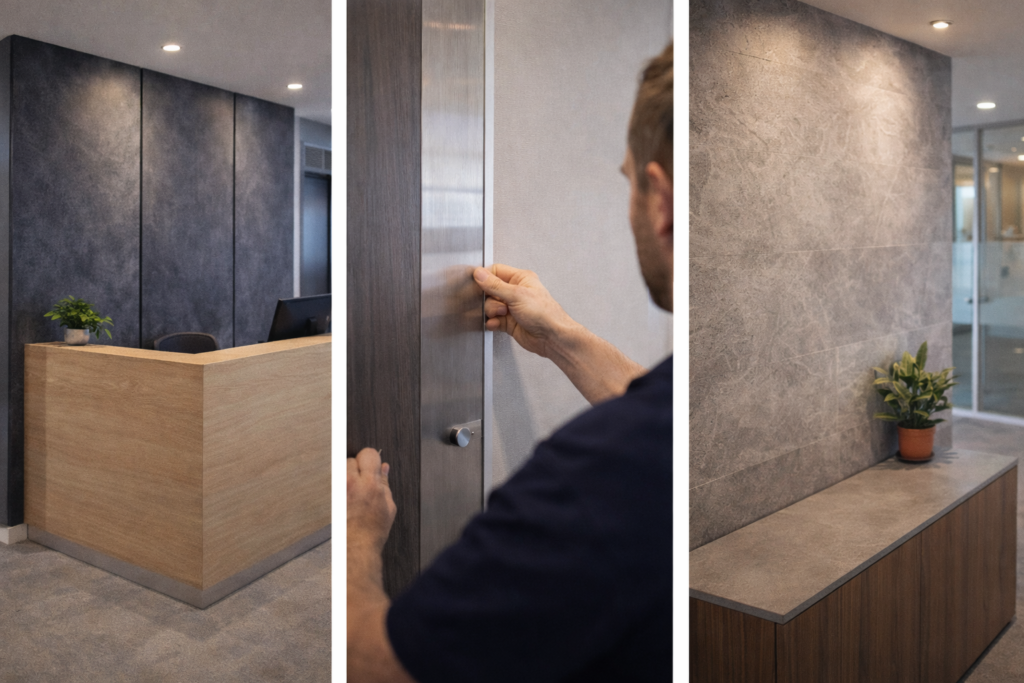
Start with sample plinths, consultation counters and storage fronts. Each substrate must be stable, smooth enough for the selected system and assessed before a quotation is finalised.
Compare physical samples of stone, clay-toned and dark matte effects under the actual lighting, beside neighbouring materials, and on a representative edge or corner where practical.
Often yes. The programme should account for heavy samples, impact-prone edges and changing collections, together with safe access, preparation time and client sign-off.
No. The substrate and coating must be sound and compatible with the selected film. Loose paint, movement, moisture and damaged edges may require repair or make wrapping unsuitable.
Send the site postcode, photographs, approximate dimensions or quantities, the intended finish and your preferred dates. Include access restrictions and any drawings or product references already specified.
For Architectural Wrapping in Stoke-on-Trent, Smiths 1972 also supports organisations in nearby towns including Newcastle-under-Lyme, Leek, Stone and Kidsgrove. Our team works from Stevenage, Hertfordshire.
Want to discuss your project?