
Clients are welcome to visit our new home – We also provide FREE DELIVERIES TO STEVENAGE, LETCHWORTH & HITCHIN
Glass-walled offices and meeting rooms make workplaces feel bright and open, but they can expose confidential conversations, computer screens and private working areas. These visibility issues often become more noticeable as teams grow, layouts change or client meetings take place throughout the day. Staff may feel overlooked, while visitors can see into rooms intended for focused or sensitive work. Office window privacy film offers a practical way to control those sight lines without replacing the glazing or making the space feel closed in. Coverage can be tailored to the people, furniture and viewing angles around each pane, helping the finished treatment feel considered rather than simply applied across every surface.
From full frosting to branded designs, the right treatment can improve discretion, reinforce your identity and help large panes of glass stand out more clearly. It can also be planned around the way each room is used, from confidential meetings and focused work to visitor-facing spaces. By choosing the right coverage, pattern and finish, businesses can improve privacy while keeping interiors bright, consistent and welcoming throughout the working day.
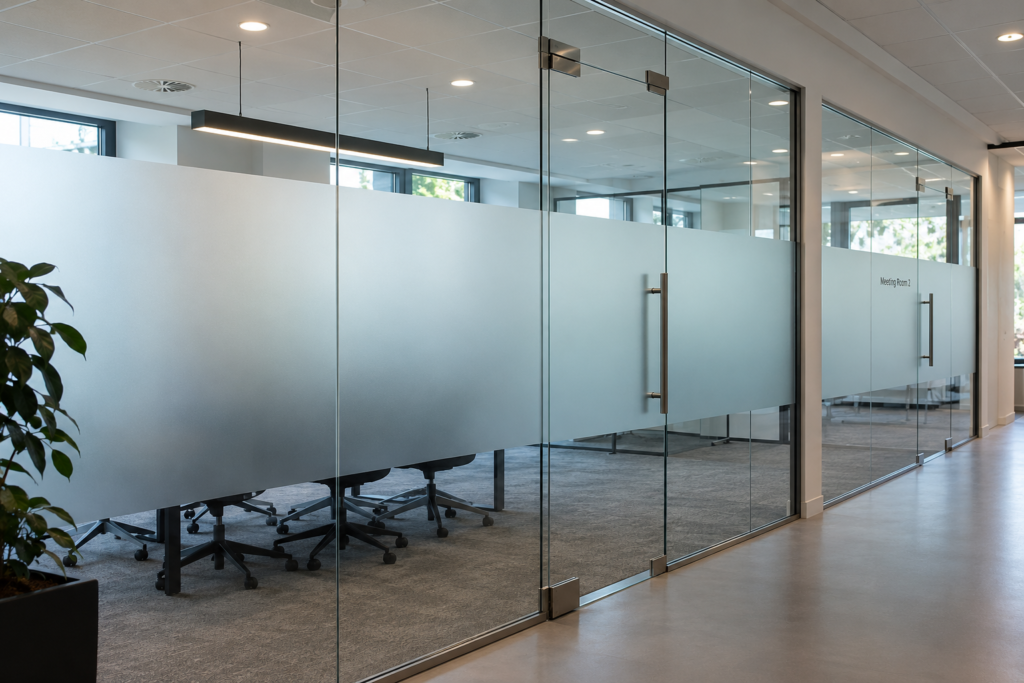
Full-coverage frosted film is a strong choice for rooms where discretion matters throughout the day. It creates an etched-glass appearance and obscures the view through the pane while continuing to diffuse daylight.
This treatment works particularly well for HR rooms, private offices, healthcare spaces, interview rooms and meeting areas used for sensitive conversations. Unlike blinds, it does not need to be opened, closed or adjusted by staff. Once installed, it provides consistent privacy with a neat, contemporary finish.
The coverage can extend across an entire pane or stop at a chosen height. A site survey helps determine which areas need complete screening and where a lighter treatment would be more appropriate.
Not every glass partition needs to be covered from top to bottom. Frosted bands can interrupt direct sight lines at seated or standing eye level while leaving more of the glazing clear.
This is often an effective office window privacy film solution for meeting rooms, corridors and shared workspaces where teams want separation without losing the open-plan character of the interior. Band height, width and spacing can be adjusted for the people using the room and the routes surrounding it.
Repeating bands can also help make large areas of clear glazing more noticeable. Where visibility and safety requirements apply, the final specification should be planned around the setting and relevant project guidance.
Privacy does not have to look generic. Logos, brand shapes, patterns, typography and graphic details can be cut into or applied over a frosted finish. This turns a functional surface into part of the wider workplace identity.
Branded frosted window film is particularly effective in reception areas, client-facing meeting rooms and head offices. A restrained design can look premium without distracting from the architecture. It can also help create a consistent visual language across several rooms or multiple locations.
For the best result, artwork should be designed specifically for glass. Fine details, viewing distance, contrast and the direction from which a logo will be seen all need consideration before production.
A gradient changes gradually from more opaque to clearer areas. It is useful when a business wants stronger coverage around desks or seated meeting positions while preserving outward views higher up the glass.
Gradient office window privacy film can soften a row of internal partitions and create a less rigid look than solid rectangular bands. It is well suited to modern offices, studios and collaborative spaces where the treatment needs to feel integrated with the interior design.
The transition can be smooth or created from dots, lines or a custom pattern. The right choice depends on the required privacy level, brand style and how people move around both sides of the glazing.
Geometric shapes, repeated motifs and custom-cut designs can break up views without fully screening a room. This approach suits breakout areas, informal meeting zones, glazed corridors and customer-facing interiors where complete privacy is unnecessary.
Patterns can range from subtle etched-effect details to a distinctive branded feature. Scale matters: a design that looks balanced on a small sample may feel too busy when repeated across a long run of glass. Accurate measurements and a visual proof make it easier to judge the finished effect before installation.
Decorative frosting can also coordinate with wall graphics, wayfinding and other interior signage to give the workplace a more joined-up appearance.
Large transparent panes can be difficult to notice, especially in bright commercial interiors. Manifestation uses visible markings – often bands, dots, logos or shapes – to make the glass easier to identify.
A carefully planned office glass treatment can support both privacy and visibility. For example, a frosted band may screen a meeting table while contrasting graphics make the pane more apparent to people approaching it. The design and positioning should reflect the building, users and applicable project requirements rather than relying on a one-size-fits-all layout.
Combining these needs within one coordinated scheme helps avoid the disjointed look that can result when privacy film, branding and visibility markings are specified separately.
The most effective result begins with how the space is actually used. Consider views from corridors, neighbouring desks, reception areas and outside the building. Check seated and standing eye levels, screen positions and the amount of daylight that reaches each room.
A professional survey can also identify access constraints, existing coatings, pane sizes and other details that affect production and installation. This reduces the risk of inconsistent coverage, awkward joins or a design that screens the wrong part of the glass.
Smiths 1972 can survey, design, manufacture and install frosted window film for commercial interiors across Hertfordshire and surrounding areas. The service can be tailored to individual meeting rooms, full office fit-outs and multi-site requirements.
For many workplaces, film provides a faster and less disruptive alternative to replacing clear glass with etched or obscure glazing. Key benefits include:
Material choice and installation quality both matter. Professionally specified film should be selected for the glazing, environment, expected lifespan and cleaning regime.
Smiths 1972 supplies and installs commercial window frosting throughout Hertfordshire. We regularly support offices, healthcare providers, schools, retailers, property teams and fit-out contractors in Stevenage, Hitchin, Letchworth Garden City, Welwyn Garden City, Hatfield, St Albans, Hertford, Royston, Borehamwood and Watford.
Our installation coverage also extends into Bedfordshire, Buckinghamshire and Cambridgeshire, together with Northampton, London and North London. Whether the requirement covers one meeting room or several business locations, we can coordinate the survey, artwork, production and installation around your programme.
Office window privacy film is a good fit when clear internal glazing creates unwanted exposure but retaining light and a sense of space remains important. It can work across one room or form part of a larger refurbishment, rebrand or office fit-out.
Before choosing a design, decide where privacy is genuinely needed, how much coverage users require and whether the glass must also carry branding or visibility markings. That makes it easier to specify a solution that looks deliberate and performs well day to day.
If you are planning privacy film for meeting rooms, partitions or external office windows, explore Smiths 1972’s commercial frosted window film service or request a survey and quotation.
The 3M Glass Finishes sample book includes more than standard full-height frosting. FASARA center and single gradations move between clearer and more private zones, while patterned, matte and crystal finishes provide different levels of screening. This gives office window privacy film projects more flexibility around seated sightlines, standing privacy, borrowed light and the need to keep glazed offices feeling open.
3M explains that quoted gradation transmission percentages are estimates for the most transparent and least transparent parts of a design and are typical, not warranted. Samples should therefore be viewed on the intended glass and under representative lighting. We also confirm current availability, glass compatibility and technical guidance before specification. View the 3M Glass Finishes sample book.
Frosted privacy film diffuses light rather than blocking it completely. The room can remain bright while direct views through the treated area are reduced.
In many cases, yes. Film can be applied to suitable existing glazing, avoiding the cost and disruption of replacing the glass. The surface and glass specification should be checked before installation.
Yes. Logos, text, brand shapes and patterns can be incorporated into a bespoke design. Artwork should be prepared for the dimensions and viewing direction of the glass.
No. A strategically positioned band, gradient or patterned treatment may provide enough privacy while keeping more of the glass clear. The best option depends on the surrounding sight lines and room use.
Yes. Frosted bands and graphics can be designed to improve privacy while making large panes easier to identify. The final layout should suit the building and its specific requirements.
Smiths 1972 installs commercial window film across Hertfordshire, including Stevenage, Hitchin, Letchworth Garden City, Welwyn Garden City, Hatfield, St Albans, Hertford, Royston, Borehamwood and Watford. We also support projects in Bedfordshire, Buckinghamshire, Cambridgeshire, Northampton, London and North London. View our frosted window film service to discuss a survey and quotation.
Want to discuss your project?