
Ready to order?
See the current formats and order the product online.
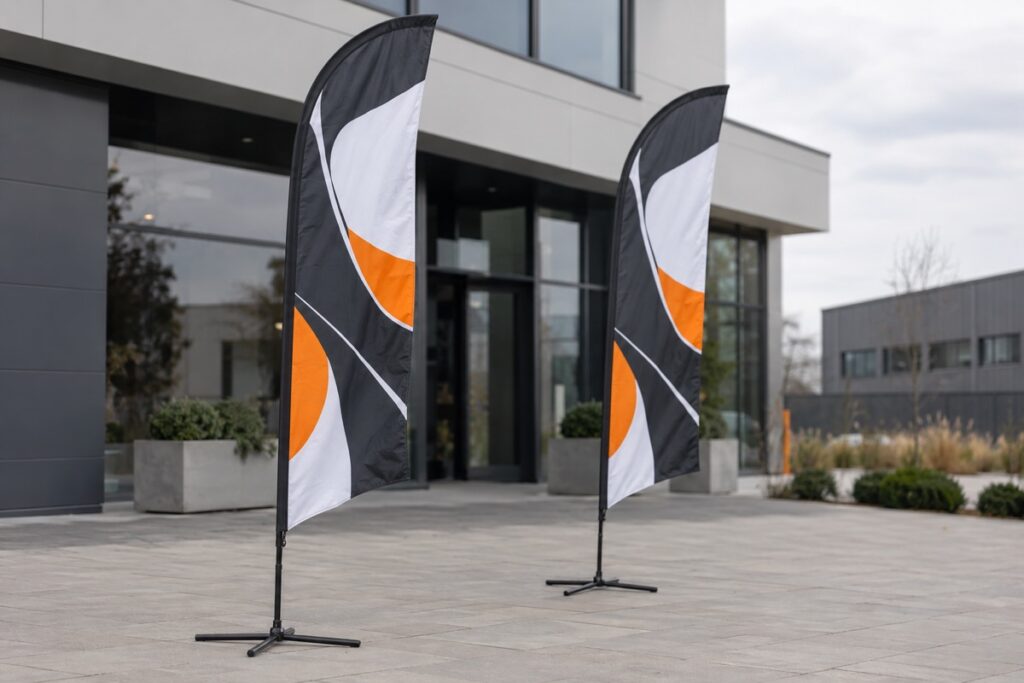
This guide compares feather fin blade crest flags, explaining how each outline affects artwork space, visibility and the choice of base.
Feather, Fin, Blade or Crest Flag: Which Shape Should You Choose?
Feather, fin, blade and crest flags use the same basic idea: a tall printed graphic held by a flexible pole. Their different outlines change how the artwork reads and how much horizontal space is available at each height.
Compare the four shapes
| Shape | Visual character | Artwork consideration |
|---|---|---|
| Feather | Familiar sweeping outside edge | Works well with vertical logos and short stacked messages |
| Fin | Broader upper area | Offers more room near the top for wider marks |
| Blade | Taut curved profile | Strong vertical silhouette with a controlled outer edge |
| Crest | More rectangular hanging area | Useful when the design needs more consistent width |
Use the product artwork template to test the real logo rather than choosing only by the empty silhouette.
Choose the height for the location
The available overall heights are 2.56m, 3.15m, 4.08m and 5.14m. Smaller flags suit exhibition halls and restricted footprints. Larger flags improve visibility outdoors but need more clear space and a base matched to the conditions.
Single-sided or double-sided print?
A single-sided knitted-polyester flag is read correctly from its main face and appears mirrored through the reverse. For that format, specify whether the pole sits to the left or right of the main view. A double-sided flag uses two printed faces so the message reads correctly from both directions. It is heavier and places different demands on the base.
When AirMesh helps
AirMesh is a perforated single-sided fabric for windier positions. The openings let more air pass through than standard knitted polyester. It does not make the system suitable for unlimited wind. The configured systems are intended for use up to Beaufort force 4 when installed correctly.
Match the base to the surface
Hard floors, soft ground and outdoor hardstanding need different base solutions. Consider the surface, pedestrian traffic, exposure and whether the flag must be moved during the day. Warranty limitations apply to bases used with double-sided flags, so read the live option notes.
Keep the artwork simple
Flags are viewed at a distance and often while moving. Use one main logo or short statement, strong contrast and large type. Keep critical information inside the safe area and avoid several small messages.
Compare all custom printed flag options
Assess the site before choosing
- Record whether the surface is soil, grass, concrete, paving or an indoor floor
- Identify the main direction from which people approach
- Check overhead restrictions, doors, trees and power lines
- Allow clear space around the moving fabric
- Plan who will take the flags down if the weather changes
Using several flags together
A row works best when the shape, height and spacing are consistent. Alternate artwork only when there is a clear campaign reason. Keep the most important mark at a similar visual height across the set so the display reads as one system rather than unrelated signs.
Storage and maintenance
Let wet fabric dry before packing it into the carry bag. Keep the pole sections clean and inspect the base, spindle and moving parts before each use. Store artwork records with the exact shape, height, print construction and pole orientation so replacement flags can be specified correctly.
Quick questions
Which flag has the widest graphic area?
Fin and crest profiles provide more horizontal room in parts of the graphic, but the exact template should guide the decision.
Do double-sided flags read correctly both ways?
Yes. They use two printed faces.
Does AirMesh make a flag safe in all weather?
No. Base selection and weather limits still apply.
For artwork preparation, Adobe provides guidance on setting print bleed. Confirm the production template, safe area and final PDF before supply.
Feather fin blade crest flags
Our local service area
Our team is based in Stevenage and serves Hertfordshire, Bedfordshire, Buckinghamshire and London. Across Hertfordshire, that includes Hitchin, Letchworth Garden City, Welwyn Garden City, Hatfield, Hertford, St Albans and Watford.